
AI reveals everything you've done wrong before. However, many companies still adopt AI systems with their eyes closed. We've interviewed IT leaders in our AI at Work report and found out that 90% of organizations haven't audited internal knowledge before deployment. 32% say their knowledge base is less than 50% accurate.
In other words, their data readiness for AI is low. The chances of successful AI adoption are slim, as employees won't be able to rely on such output. Systems will hallucinate or mislead due to poor data quality and a lack of governance.
Preparing data takes time and continuous effort, but it's the right move. Learn what AI-ready data looks like and the steps to achieve data readiness in our post.
What is data readiness for AI?
Data readiness for AI means an organization's data is good enough to be used for AI reliably, without a human first cleaning or interpreting it. It's a combination of data accuracy, data completeness, structuredness, and governance. Assessing AI data readiness means checking whether a system can find the necessary data, understand it, and act on it safely.
What data readiness looks like in practice
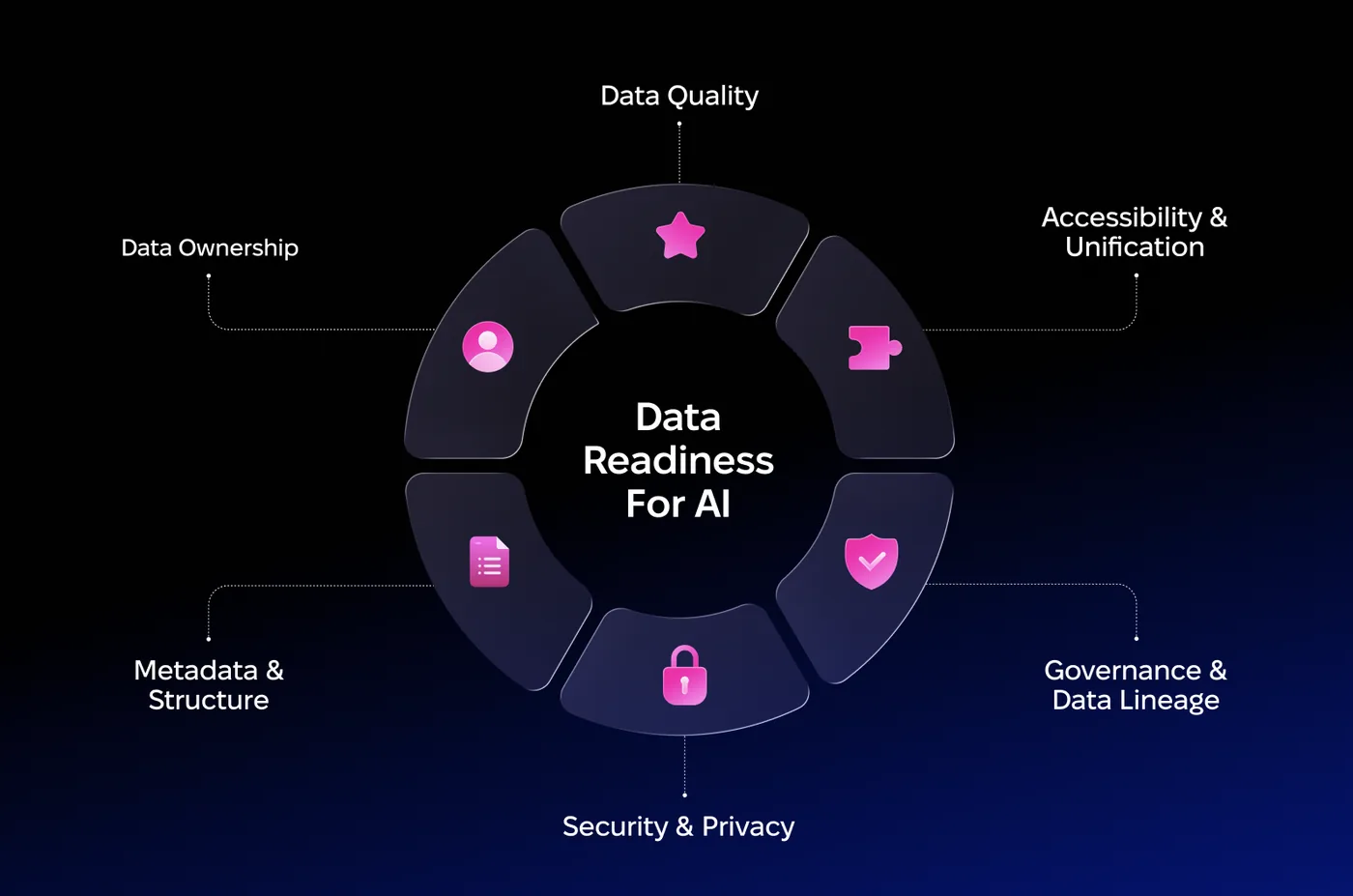
To understand whether your data is ready, you should know what to check. The problem is that the concept of AI data readiness is vague. You need to assess multiple aspects, such as:
- Data quality: accuracy, completeness, consistency, timeliness.
- Accessibility and unification: no data silos, smoother data integration.
- Governance and data lineage: transparent policies, data provenance, and traceability.
- Security and privacy: sufficient access controls, data classification, and regulatory compliance.
- Metadata and structure: proper labeling, tagging, semantic context.
- Data ownership: teams with outlined data responsibilities.
A recent review of dataset readiness methods also lists the impact of data on AI as a readiness factor. The authors reviewed over 140 papers and found that both data content and its relevance to the AI application matter. Teams can use feature relevance and data point impact as additional signals that their data is suitable for AI.
Why AI data readiness matters
AI data readiness ensures you feed the system with well-managed, high-quality data and makes the outcome more predictable. You've probably heard about the garbage in, garbage out (GIGO) principle. It applies directly to the use of large language models (LLMs) and other AI systems whose output directly depends on what you feed them.
Proper data helps increase accuracy, reduce data bias, and minimize privacy issues, along with other benefits:
- More accurate AI output. Complete and consistent data improves model performance and helps avoid misleading or irrelevant responses.
- Reduced bias. Representative and balanced datasets minimize unfair outcomes, which is particularly important when using AI for HR and other people-related workflows.
- Faster AI deployment. Data readiness allows teams to focus on AI development and implementation rather than spending time cleaning datasets.
- Regulatory compliance. Knowledge maintenance reduces security risks and improves transparency and explainability of AI systems, which helps pass audits.
- Improved AI governance. AI-ready datasets already have data privacy policies and quality controls. This clarifies ownership and embeds governance into workflows.
- Reusable for other projects. Properly maintained data assets are ready for other AI initiatives, which speeds up further AI implementation.
Data readiness also helps build trust in AI tools. When teams get honest answers each time they ask something, they are more likely to rely on the output. This solves a real efficiency problem: 98% of organizations verify outputs before acting. When people don't need to double-check every response, they work faster and more confidently.
Most organizations aren't data-ready
The AI at Work report shows that most organizations are not actually ready to connect AI systems (even if they think so). Only 10% audited their documentation extensively before deploying AI.
Based on our experience and interviews with IT leaders, the main barriers to preparing a knowledge base include:
Data silos and fragmentation
The use of multiple unrelated tools across departments creates data silos. You may end up with a large volume of disconnected data that is difficult to use. The lack of fixed structure, inconsistent formats, and noise complicate cleaning so much that many organizations skip it altogether. The result? Poorly integrated and inaccurate AI.
"Since AI models require clean, contextual, and accessible data, data trapped in heavily fragmented, outdated legacy systems cannot communicate with modern APIs."
— Carla, Head of Red Team, Medium company
Poor data quality
Before AI, organizations didn't care about data completeness and consistency that much. Now, when they layer language models on top of existing systems, AI doesn't work as expected. No surprise here. Initially poor data produces poor output.
Unstructured data
Larger organizations are more likely to accumulate large volumes of unstructured data. Emails, documents, PDFs, images, videos, and chat logs have different formats. These organizations will need to extract meaningful information and convert it into a readable format to get ready for AI.
Weak governance and security
Organizations without clear policies for data ownership, access control, and privacy are not ready for AI-related risks. AI needs strict guardrails to work reliably and keep confidential information private.
"The nature of our work puts a lot of sensitive and proprietary data in play, so we heavily vet each and every tool before deploying them for mass usage... Data security is at the forefront of our policy base and can often feel like a barrier."
— Kenya, IT Director, Mid-Market IT Services
Skills gaps and lack of data literacy
Preparing data requires prior experience and skills. Few companies have data engineering, data science, AI, and data governance experts on board. It creates bottlenecks and delays data preparation and subsequent AI adoption.
How to get your data AI-ready
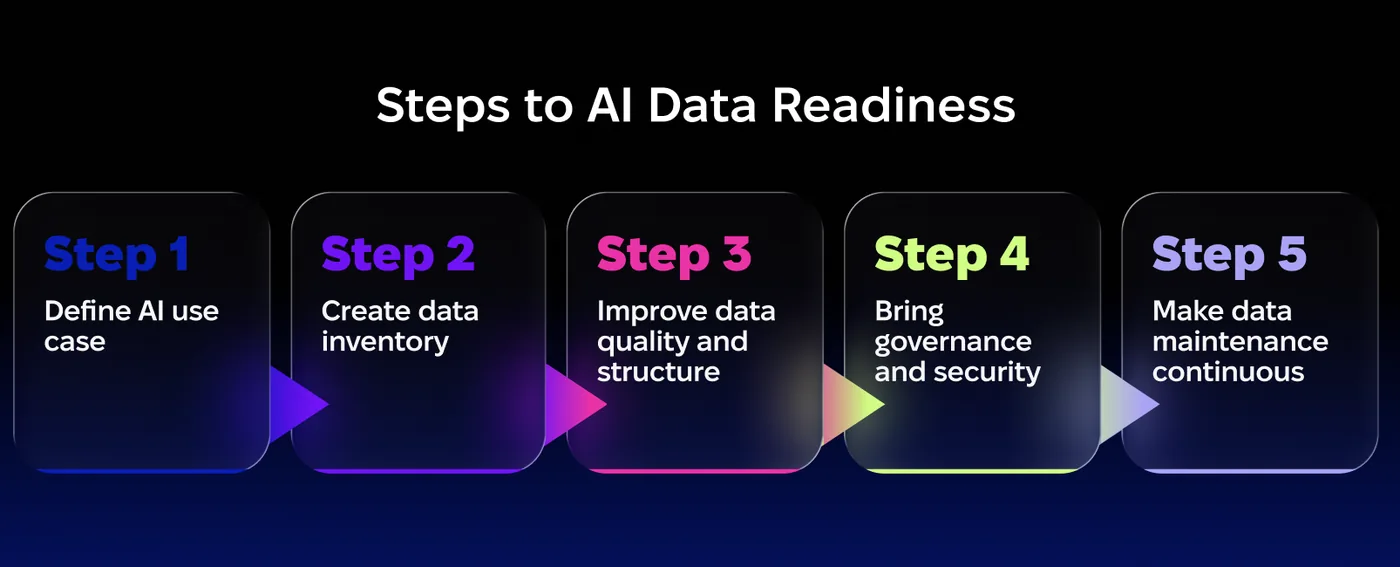
Data readiness for AI requires an intentional effort to change your data management approaches. You need to regularly review and label data, remove outdated information, and assign a dedicated owner to each dataset. It also takes organization-wide policies to govern data generation and processing. Here's what you can do to prepare data.
1. Define your AI use case
Choosing the right type of data for a specific use case is part of preparation. Understand what business problem you are trying to solve with AI automation to determine what data you actually need. It will allow you to focus on relevant datasets and workflows.
2. Create a data inventory
List all the details related to the use case. You should track where data is stored, who owns it, how often it's updated, and its quality. It can be helpful to score against the data maturity model for data readiness assessment and to see gaps.
"Ask teams to catalog what data exists and differentiate between current and superseded. Policies, compliance documentation, regulatory guidance, and other frequently updated records are usually considered stale after twelve months."
3. Improve data quality and structure
Once you know the gaps, start fixing data. Remove duplicates, fix missing values, standardize formats, and correct errors.
The next step is making data more easily digestible for AI. You will need to create consistent schemas, label important fields, connect datasets, and adopt other metadata management approaches.
You will also need a dedicated person to manage data and keep it in order. Larger organizations have a Chief Data Officer (CDO) role for this. Smaller ones may assign data owners for different datasets.
"Make sure each workflow you automate with AI has a person responsible for accuracy and a defined review cadence. Consistent naming conventions, taxonomies, and formatting also help the model interpret and connect information across documents."
4. Establish governance and security
Implement access controls, data lineage, audit trails, and version control to secure data. You need guardrails to prevent AI from processing and disclosing private information it shouldn't touch. At the same time, make sure data stays accessible by keeping it in isolated systems with granular access.
5. Make data maintenance continuous
Build reliable data pipelines for data ingestion, cleaning, validation, transformation, and monitoring. Besides initial preparation, you must ensure data always stays ready for efficient AI use. AI systems tend to drift, which affects their accuracy.
"Deduplication, versioning, and content expiration must be ongoing workflows. There are specialized AI tools to flag outdated content, exclude stale records from indexing, and catch mismatches across documents."
We also recommend regularly assessing data quality and gathering user feedback. Your teammates will tell you about their AI disappointments. Make sure to analyze what caused them and review related data management approaches if needed.
Data readiness assessment (quick checklist)
If you want a quick assessment, use a data readiness checklist provided below. It covers the main things to do before adding AI tools on top of your data.
- AI use case is defined
- Data sources are identified and documented
- Data ownership is defined for selected datasets
- Data governance framework is established for the full data lifecycle
- Security requirements and access controls are defined
- Required data is available and accessible
- Data storage and retrieval infrastructure are established
- Dataset volume is sufficient for the chosen model and use
- Dataset represents diversity and edge cases
- Historical data meets the required time range
- Data cleansing, validation, and monitoring are ongoing
- Regulatory compliance requirements are identified and met
- Third-party data sourcing is documented and vetted
- Continuous data maintenance is established
Summing up
Data readiness for AI requires both improving your existing data and workflows that keep data suitable for AI. You also need to enhance data ownership, set up governance, and make other profound changes for continuous data maintenance.
Getting ready for AI adoption directly determines its success and ROI. Things get even more complicated if you choose custom AI development over vendor-provided solutions. Low data readiness often surfaces after a build is already underway. Changing something at this point requires much more effort and higher costs.
AI is not magic. It will deliver exactly what you put into it, which is exactly why data readiness has to come first.
FAQs
How do you assess if data is ready for AI?
To assess data readiness for AI, you need to check its cleanliness, completeness, accessibility, and consistency. It's also necessary to establish clear data governance, validate security and compliance requirements, and ensure data relevance for a specific AI use case.
What makes data unsuitable for AI?
Data may be unsuitable for AI when it's inaccurate, biased, disorganized, or not relevant to the intended problem. Some other cases include inconsistent formats, missing context, and unprotected personal data. However, you typically can prepare such data for successful AI adoption through cleaning, formatting, deduplication, labeling, and anonymization.
Is unstructured data AI-ready?
No, unstructured data is not AI-ready by default. It often exists in formats such as emails, PDFs, images, or chat logs that AI systems may be unable to process. For smooth processing, unstructured data requires prior cleaning, classification, and metadata enrichment. Otherwise, the risks of hallucinations and poor retrieval increase.
What's the difference between data quality and data readiness?
The main difference is that data readiness is a broader concept that includes data quality along with other requirements. Data quality focuses on the internal characteristics such as accuracy, completeness, consistency, and reliability. Data readiness assesses whether a knowledge base is fully prepared for an intended AI use case.
How do I know if my data is ready for AI?
Data is ready for AI when it delivers a single source of truth, has consistent formatting, and provides documented lineage. It also must be accessible for AI tools and relevant to the desired use case. If your team regularly makes manual data fixes or uses conflicting reports, your current data may require additional preparation before AI deployment.